Ocean wave energy is a renewable resource that converts the motion of sea waves into electricity by means of wave energy converters (WECs). With one of the highest energy densities among renewable sources and strong complementarity with wind and solar, it is regarded as a promising contributor to the future energy mix, particularly for coastal and island communities. Unlike more mature renewables, however, the field has not yet converged toward a single dominant technology: a wide variety of device concepts is still being explored, which makes their modelling, control, and estimation especially open and challenging research problems.
WECs operate in a highly dynamic and uncertain environment, continuously excited by waves that cannot be measured directly. Extracting the maximum possible energy is not a conventional stabilisation or set-point-tracking problem: it calls for economic, energy-maximising control formulations, typically based on predictive strategies. These strategies deliberately push devices beyond the validity range of their simplified hydrodynamic models, so that accurate control-oriented modelling, real-time estimation, and robust autonomous operation become tightly coupled challenges, combining hard fundamental problems with high potential impact on the energy transition.
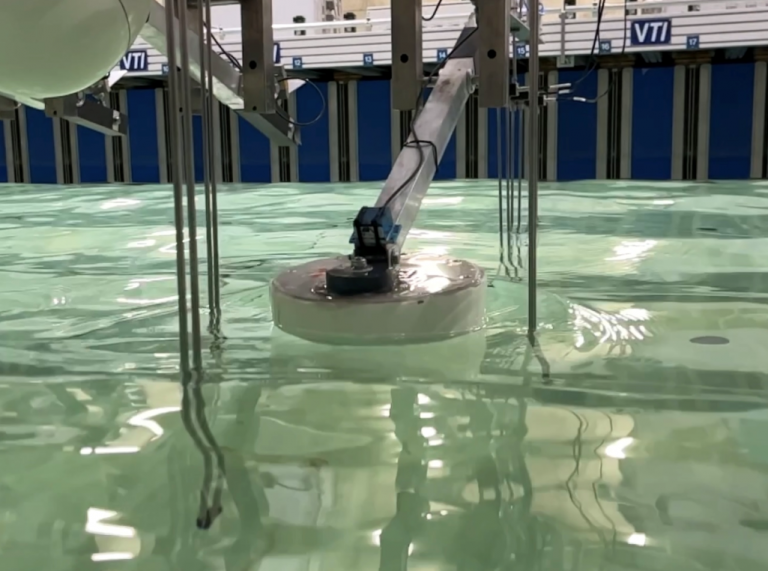
Scaled WaveStar device prototype tested in a wave basin facility.
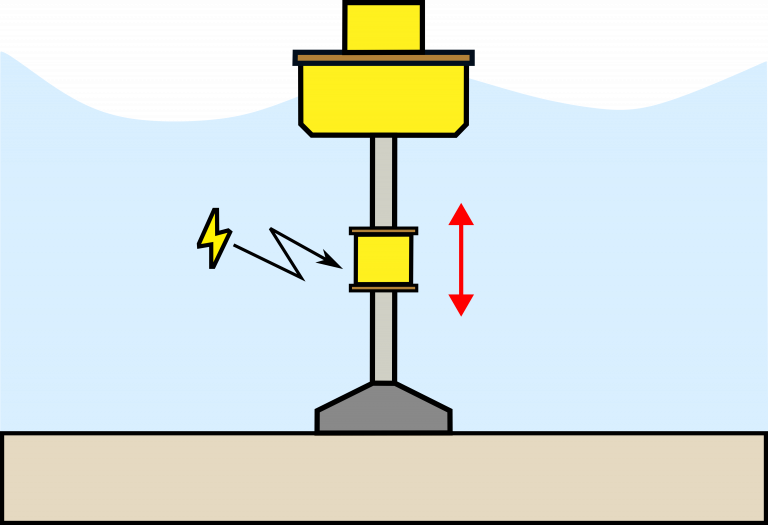
Wave energy concepts: Heaving point absorber
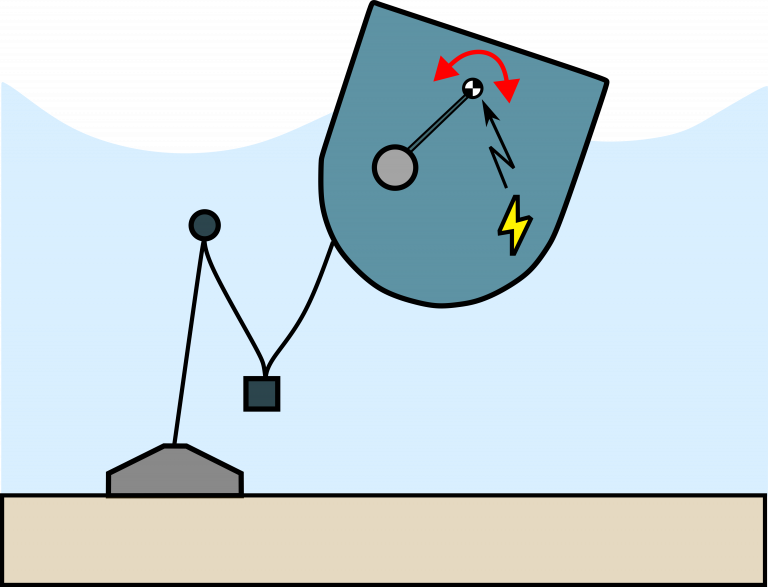
Wave energy concepts: Inertial pitching wave energy converter.
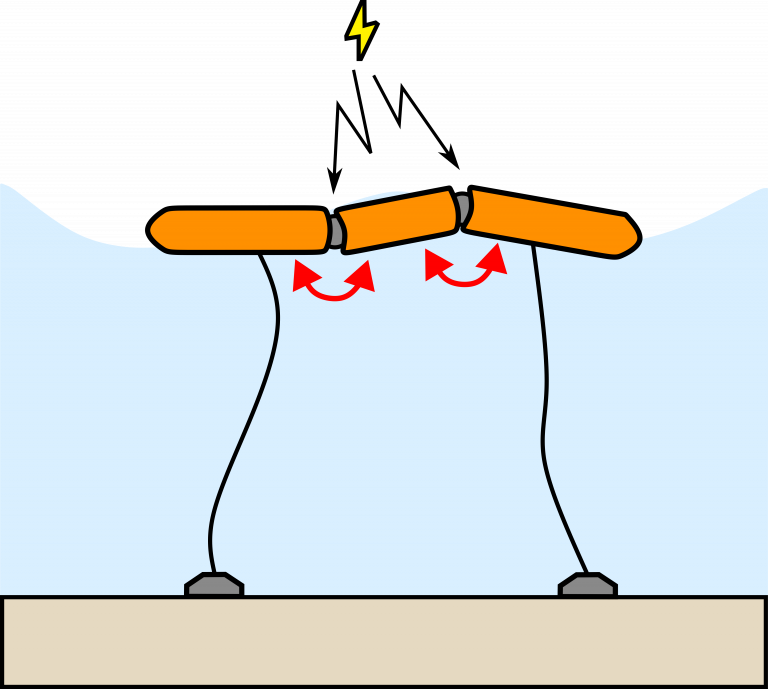
Wave energy concepts: Attenuator wave energy converter.
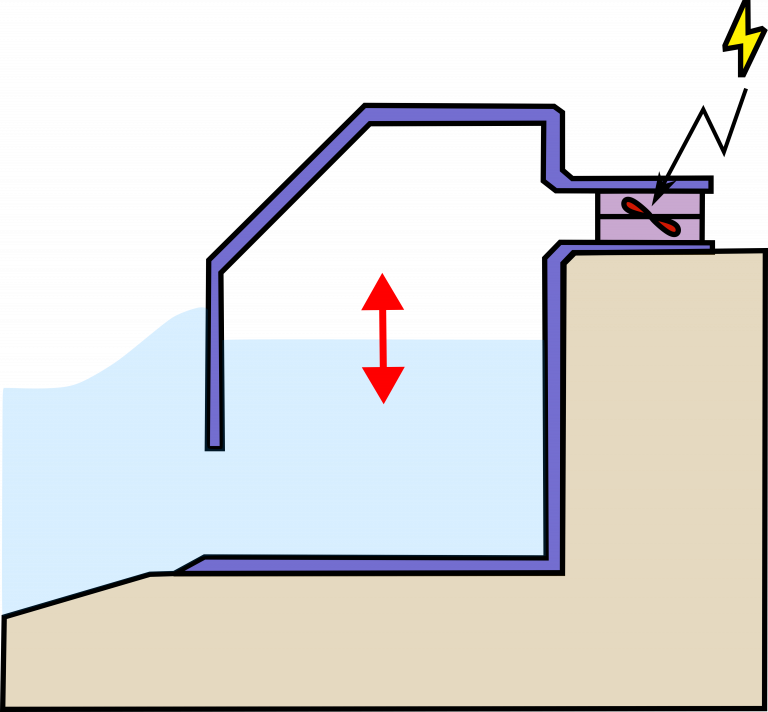
Wave energy concepts: Oscillating water column.
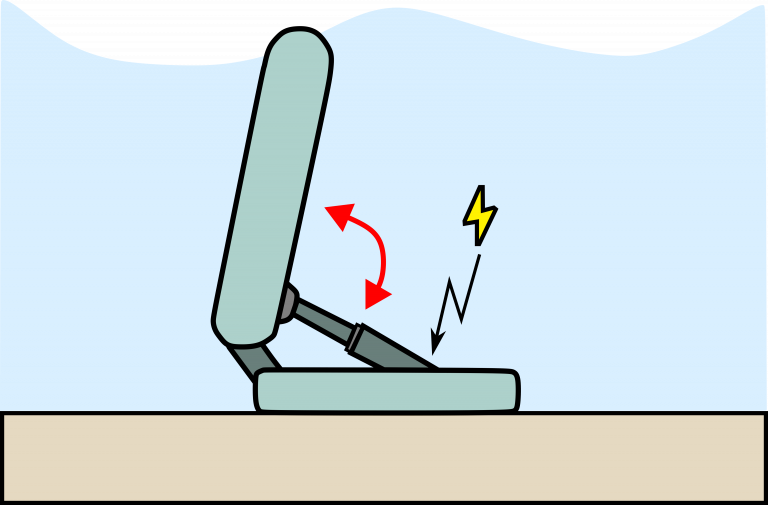
Wave energy concepts: Oscillating surge wave energy converter.
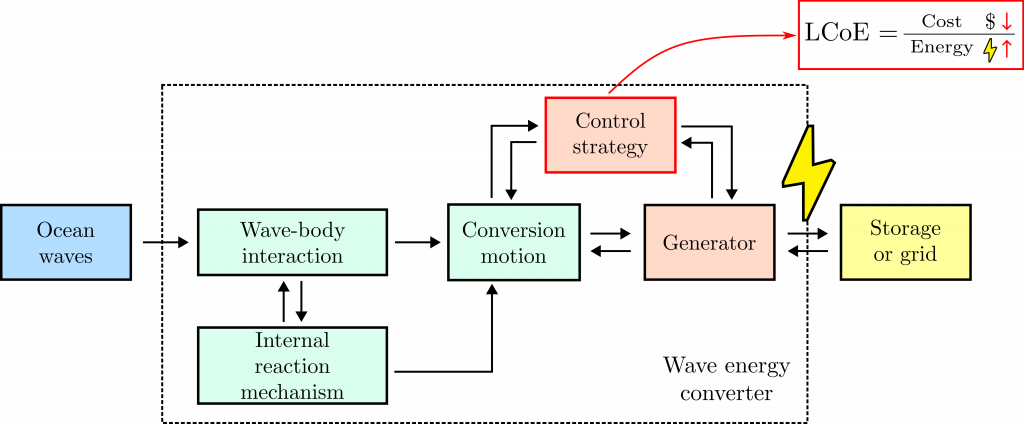
Wave energy conversion principle.
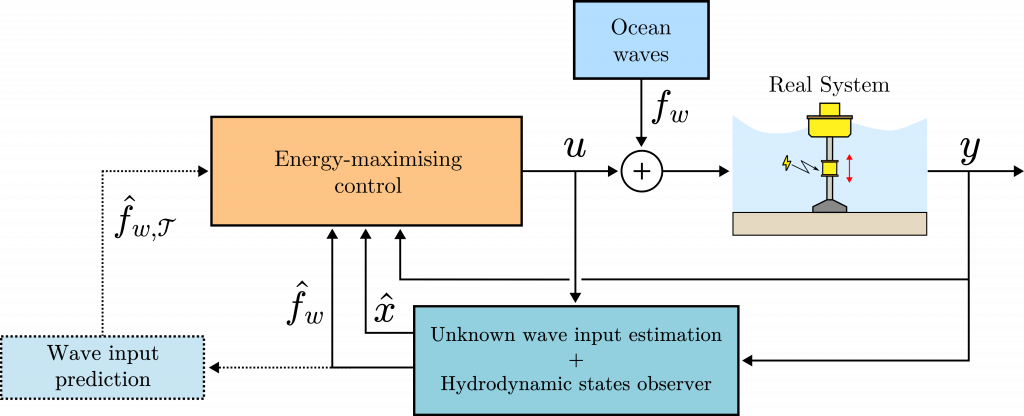
Standard wave energy control loop.
In the field of ocean wave energy, the SAS-Lab carries out research on the following topics:
Control-oriented modelling and system identification of wave energy systems from experimental data;
Energy-maximising control, including model predictive control and data-driven / direct impedance-matching approaches;
Development and experimental validation of WEC control solutions, spanning both methodological design and the real-time deployment of complete control loops (controllers, estimators, and predictors) under realistic operating conditions;
Real-time estimation of unmeasured wave excitation forces and hydrodynamic states (unknown-input and state estimation);
Control co-design, i.e. the simultaneous optimisation of device design and control strategy;
Investigation and comparison of novel wave energy concepts;
Coordinated control of WEC arrays and farms, accounting for the hydrodynamic interactions between devices;
Characterisation of the wave resource from sparse in-situ and satellite metocean data;
Integration of wave and offshore energy into coastal communities.