
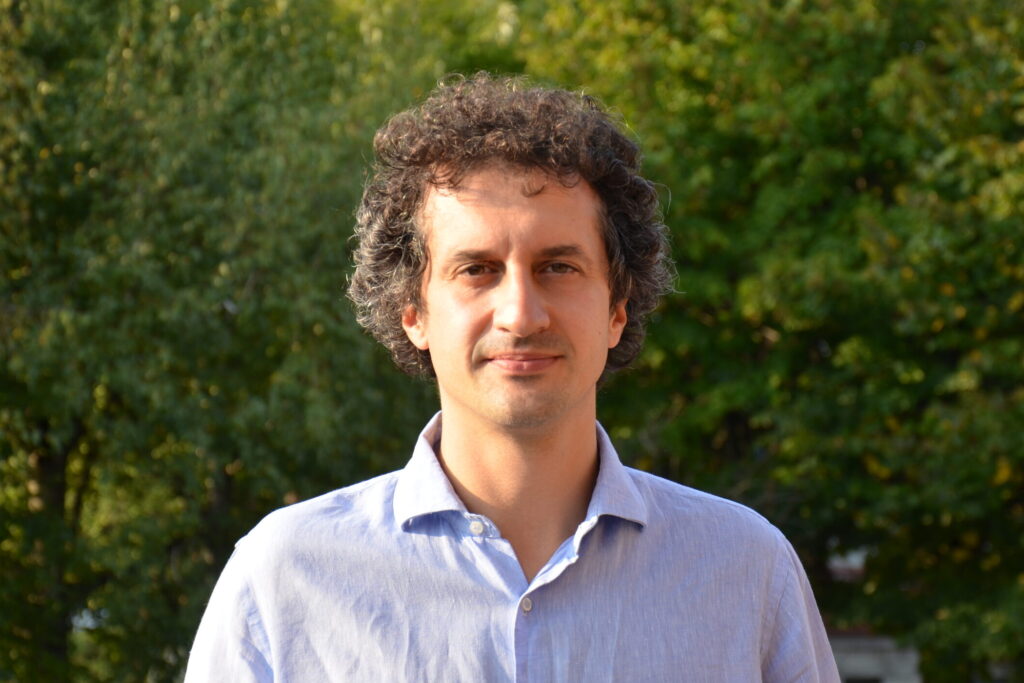
Lorenzo Fagiano is full professor of automation and control engineering at the Politecnico di Milano since 2024. He received the Ph.D. in Information and Systems Engineering in 2009 from Politecnico di Torino. From 2010 to 2016 he held positions at UC Santa Barbara, ETH Zurich, and ABB Corporate Research, Switzerland, and from 2016 to 2023 he was associate professor at Politecnico di Milano. He is recipient of the European Control Award 2019, of the Mission Innovation Champion award 2019, of two Marie Curie fellowships, of the 2011 IEEE Transactions on Systems Technology Outstanding Paper Award, and of the 2010 ENI award “Debut in Research” prize.
Journal Publications
Catenaro, Edoardo; Sabug, Lorenzo; Panzani, Giulio; Sette, Davide; Ruiz, Fredy; Fagiano, Lorenzo; Savaresi, Sergio M.
Automatic Learning-Based Calibration of Assisted Motorcycle Gearshift: A Comparative Study Journal Article
In: IEEE Transactions on Control Systems Technology, 2025.
@article{Catenaro2025,

title = {Automatic Learning-Based Calibration of Assisted Motorcycle Gearshift: A Comparative Study},

author = {Edoardo Catenaro and Lorenzo Sabug and Giulio Panzani and Davide Sette and Fredy Ruiz and Lorenzo Fagiano and Sergio M. Savaresi},

url = {https://www.scopus.com/inward/record.uri?eid=2-s2.0-105004672295&doi=10.1109%2fTCST.2025.3561504&partnerID=40&md5=9721bf3ba2794fb9cbd698537f8aaf75},

doi = {10.1109/TCST.2025.3561504},

year  = {2025},

date = {2025-01-01},

urldate = {2025-01-01},

journal = {IEEE Transactions on Control Systems Technology},

abstract = {A comparison of different approaches to the automatic online, data-driven calibration of assisted gearshift settings for a motorcycle is presented. An objective function associated with the component stress and clutch resynchronization time is exploited and optimized during operation using different strategies: from naïve space-filling approaches to learning-based black-box optimization algorithms. The performance of various methods is compared in real-world experiments using metrics related to the experimental convergence rate and the quality of the best found result. © 1993-2012 IEEE.},

keywords = {},

pubstate = {published},

tppubtype = {article}

}
Ahmed, Syed Hassan; Bonetti, Tommaso; Fagiano, Lorenzo
Periodic Disturbance Learning Model Predictive Control Journal Article
In: IEEE Control Systems Letters, 2025.
@article{Ahmed2025,

title = {Periodic Disturbance Learning Model Predictive Control},

author = {Syed Hassan Ahmed and Tommaso Bonetti and Lorenzo Fagiano},

url = {https://www.scopus.com/inward/record.uri?eid=2-s2.0-105010219505&doi=10.1109%2fLCSYS.2025.3586633&partnerID=40&md5=ad42d331d4a119b26ac13d3387a4e55d},

doi = {10.1109/LCSYS.2025.3586633},

year  = {2025},

date = {2025-01-01},

journal = {IEEE Control Systems Letters},

abstract = {A novel Model Predictive Control (MPC) framework called disturbance-learning MPC (DL-MPC) for constrained LTI systems subject to bounded disturbances is proposed. The primary objective is to improve the disturbance rejection performance of the tube-based MPC (tube-MPC) law, especially focusing on periodic disturbance signals. Based on convex optimization, the method uses real-time measurements to learn a model of the disturbance, to predict its future behavior. By including this model in the MPC, the latter can proactively counteract the disturbance, significantly improving closed-loop performance. The presented technique includes the disturbance model while preserving robust recursive feasibility and constraint satisfaction. The effectiveness of DL-MPC is demonstrated through simulation of a multivariable nonlinear system, a Continuous-flow Stirred Tank Reactor, subject to periodic disturbances. The results clearly show enhanced tracking accuracy compared to nominal MPC and tube-MPC methods. © 2017 IEEE.},

keywords = {},

pubstate = {published},

tppubtype = {article}

}
Kessler, Nicolas; Fagiano, Lorenzo
On Gain Scheduling Trajectory Stabilization for Nonlinear Systems: Theoretical Insights and Experimental Results Journal Article
In: International Journal of Robust and Nonlinear Control, vol. 35, no 6, pp. 2142 – 2155, 2025, (All Open Access, Green Open Access, Hybrid Gold Open Access).
@article{Kessler20252142,

title = {On Gain Scheduling Trajectory Stabilization for Nonlinear Systems: Theoretical Insights and Experimental Results},

author = {Nicolas Kessler and Lorenzo Fagiano},

url = {https://www.scopus.com/inward/record.uri?eid=2-s2.0-86000427164&doi=10.1002%2frnc.7784&partnerID=40&md5=60657f166d42065468d94f1366f650bd},

doi = {10.1002/rnc.7784},

year  = {2025},

date = {2025-01-01},

journal = {International Journal of Robust and Nonlinear Control},

volume = {35},

number = {6},

pages = {2142 – 2155},

abstract = {Steering a nonlinear system from an initial state to a desired one is a common task in control. While a nominal trajectory can be obtained rather systematically using a model, for example, via numerical optimization, heuristics, or reinforcement learning, the design of a computationally fast and reliable feedback control law that guarantees bounded deviations around the found trajectory can be much more involved. An approach that does not require high online computational power and is well-accepted in industry is gain-scheduling. The results presented here pertain to the boundedness guarantees and the set of safe initial conditions of gain-scheduled control laws, based on subsequent linearizations along the reference trajectory. The approach bounds the uncertainty arising from the linearization process, builds polytopic sets of linear time-varying systems covering the nonlinear dynamics along the trajectory, and exploits sufficient conditions for the existence of a robust polyquadratic Lyapunov function to attempt the derivation of the desired gain-scheduled controller via the solution of linear matrix inequalities (LMIs). A result to estimate an ellipsoidal set of safe initial conditions is provided too. Moreover, arbitrary scheduling strategies between the control gains are considered in the analysis, and the method can also be used to check/assess the boundedness properties obtained with an existing gain-scheduled law. The approach is demonstrated experimentally on a small quadcopter, as well as in simulation to design a scheduled controller for a chemical reactor model and to validate an existing control law for a gantry crane model. © 2025 The Author(s). International Journal of Robust and Nonlinear Control published by John Wiley & Sons Ltd.},

note = {All Open Access, Green Open Access, Hybrid Gold Open Access},

keywords = {},

pubstate = {published},

tppubtype = {article}

}
Mohammed, Tareg; Busk, Jørgen; Oland, Espen; Fagiano, Lorenzo
Large-Scale Reverse Pumping for Rigid-Wing Airborne Wind Energy Systems Journal Article
In: Journal of Guidance, Control, and Dynamics, vol. 47, no 8, pp. 1748 – 1758, 2024.
@article{Mohammed20241748,

title = {Large-Scale Reverse Pumping for Rigid-Wing Airborne Wind Energy Systems},

author = {Tareg Mohammed and Jørgen Busk and Espen Oland and Lorenzo Fagiano},

url = {https://www.scopus.com/inward/record.uri?eid=2-s2.0-85201687286&doi=10.2514%2f1.G007859&partnerID=40&md5=022d3ef14b7aa30dcd28668b0b7a4c6e},

doi = {10.2514/1.G007859},

year  = {2024},

date = {2024-01-01},

journal = {Journal of Guidance, Control, and Dynamics},

volume = {47},

number = {8},

pages = {1748 – 1758},

keywords = {},

pubstate = {published},

tppubtype = {article}

}
Trombini, Sofia; Pasta, Edoardo; Fagiano, Lorenzo
On the kite-platform interactions in offshore Airborne Wind Energy Systems: Frequency analysis and control approach Journal Article
In: European Journal of Control, vol. 80, 2024, (All Open Access, Green Open Access, Hybrid Gold Open Access).
@article{Trombini2024,

title = {On the kite-platform interactions in offshore Airborne Wind Energy Systems: Frequency analysis and control approach},

author = {Sofia Trombini and Edoardo Pasta and Lorenzo Fagiano},

url = {https://www.scopus.com/inward/record.uri?eid=2-s2.0-85196822443&doi=10.1016%2fj.ejcon.2024.101065&partnerID=40&md5=662a7b724fd8ae32429e343613eaa49d},

doi = {10.1016/j.ejcon.2024.101065},

year  = {2024},

date = {2024-01-01},

journal = {European Journal of Control},

volume = {80},

abstract = {This study investigates deep offshore, pumping Airborne Wind Energy systems, focusing on the kite-platform interaction. The considered system includes a 360 m2 soft-wing kite, connected by a tether to a winch installed on a 10-meter-deep spar with four mooring lines. Wind power is converted into electricity with a feedback controlled periodic trajectory of the kite and corresponding reeling motion of the tether. An analysis of the mutual influence between the platform and the kite dynamics, with different wave regimes, reveals a rather small sensitivity of the flight pattern to the platform oscillations; on the other hand, the frequency of tether force oscillations can be close to the platform resonance peaks, resulting in possible increased fatigue loads and damage of the floating and submerged components. A control design procedure is then proposed to avoid this problem, acting on the kite path planner. Simulation results confirm the effectiveness of the approach. © 2024 The Authors},

note = {All Open Access, Green Open Access, Hybrid Gold Open Access},

keywords = {},

pubstate = {published},

tppubtype = {article}

}
Conference publications
Alborghetti, Mattia; Trevisi, Filippo; Boffadossi, Roberto; Fagiano, Lorenzo
European Control Conference 2025, 2025.
@conference{alborghetti2025,

title = {Optimal Power Smoothing of Airborne Wind Energy Systems Via Pseudo-Spectral Methods and Multi-Objective Analysis},

author = {Mattia Alborghetti and Filippo Trevisi and Roberto Boffadossi and Lorenzo Fagiano},

url = {https://www.sas-lab.deib.polimi.it/?attachment_id=1544},

doi = {to appear},

year  = {2025},

date = {2025-06-27},

urldate = {2025-06-27},

booktitle = {European Control Conference 2025},

abstract = {The problem of optimizing the power output of a class of Airborne Wind Energy Systems (AWES), named fly-gen, is considered. Fly-gen AWES, called windplanes in this paper, harvest wind power by means of an autonomous tethered aircraft that carries out periodic trajectories roughly perpendicular to the wind flow (crosswind conditions), using on-board turbines and converters and an electric tether to transfer power to the ground. The amount of generated power and its variability strongly depend on the flown trajectory, whose optimization is a highly nonlinear and non-convex problem. Differently from most of the existing literature on the topic, this problem is here addressed from a multi-objective perspective, where both the average power and its variability are considered. Through a recently-proposed pseudo-spectral decomposition of the states and inputs, a rather small-scale nonlinear program is derived to obtain a periodic orbit that maximizes the average power under a constraint on its variability. Then, a series of such programs is formulated and solved to approximate the Pareto front of the problem. Finally, the latter is exploited to analyze the possible trade-offs. The main finding of this work is that, contrary to what postulated so far in the scientific community, it is possible to operate the windplane with minimal power fluctuations (10% of the average) with a very small reduction of mean power, of the order of 5% with respect to the maximum achievable. Additional considerations regarding the sensitivity of the optimal trajectories to various factors are presented, too. These results pave the way for a completely novel way of optimizing and controlling windplanes.},

keywords = {},

pubstate = {published},

tppubtype = {conference}

}
Trevisi, Filippo; Sabug, Lorenzo; Fagiano, Lorenzo
A Gaussian wake model for Airborne Wind Energy Systems Conference
Wake Conference 2025 Visby, Sweden, vol. 3016, no 1, Journal of Physics: Conference Series 2025.
@conference{Trevisi2025,

title = {A Gaussian wake model for Airborne Wind Energy Systems},

author = {Filippo Trevisi and Lorenzo Sabug and Lorenzo Fagiano},

url = {https://www.scopus.com/inward/record.uri?eid=2-s2.0-105007615616&doi=10.1088%2f1742-6596%2f3016%2f1%2f012038&partnerID=40&md5=e2dceed356557b4c5caec901a97faf58},

doi = {10.1088/1742-6596/3016/1/012038},

year  = {2025},

date = {2025-01-01},

urldate = {2025-01-01},

booktitle = {Wake Conference 2025 Visby, Sweden},

journal = {Journal of Physics: Conference Series},

volume = {3016},

number = {1},

series = {Journal of Physics: Conference Series},

abstract = {Modeling the aerodynamic interactions between Airborne Wind Energy Systems (AWES) is an open and challenging problem. To this end, a new Gaussian wake model is introduced for fly-gen AWES, also called windplanes here. The engineering wake models of windplanes can be split in induction models, used to find the induced velocities at the wing, and wake models, used to account for the wind deficit downwind. The proposed model combines an improved induction model, starting from one available in the literature, with a novel wake model that assumes that the wake velocity has a Gaussian shape and imposes momentum conservation. The variance of the Gaussian wake is assumed to vary with the downstream distance from the windplane. The model entails just one tuning parameter that is estimated using CFD results from the literature, showing high accuracy. The new model is then used to study the influence of an upwind system on a downwind one. A sensitivity analysis is carried out by moving the downwind system in the direction transverse to the wind speed or by yawing it with respect to the wind direction. A maximum in power production of the downwind system is found when the projections of the two trajectories are partially overlapping. The extremely low computational cost of the model and the physical insights provided by this paper contribute to clear the way for simulation, planning and control of large scale airborne wind farms. © Published under licence by IOP Publishing Ltd.},

keywords = {},

pubstate = {published},

tppubtype = {conference}

}
Meza, Gonzalo; Lowenstein, Kristoffer Fink; Fagiano, Lorenzo
Obstacle avoidance for a robotic manipulator with linear-quadratic Model Predictive Control Conference
2024.
@conference{Meza20243365,

title = {Obstacle avoidance for a robotic manipulator with linear-quadratic Model Predictive Control},

author = {Gonzalo Meza and Kristoffer Fink Lowenstein and Lorenzo Fagiano},

url = {https://www.scopus.com/inward/record.uri?eid=2-s2.0-85208276051&doi=10.1109%2fCASE59546.2024.10711546&partnerID=40&md5=dc5df15c31ee283e5083ebcec6b1e560},

doi = {10.1109/CASE59546.2024.10711546},

year  = {2024},

date = {2024-01-01},

journal = {IEEE International Conference on Automation Science and Engineering},

pages = {3365 – 3370},

abstract = {The problem of moving a six-degrees-of-freedom manipulator in an environment with unknown obstacles is considered. The manipulator is assumed to be equipped with an exteroceptive sensor that provides a partial sampling of the surroundings. A hierarchical control layout is proposed: in the outer layer, a path planner generates an obstacle-free trajectory based on the available local information; in the inner layer, an Inverse-Kinematics Model Predictive Controller tracks the trajectory while reactively avoiding unseen obstacles and self-collisions at a higher rate. By constructing a polytopic under-approximation of the free environment and employing a linearization of the task, the predictive controller features a convex quadratic cost and linear constraints, thus requiring the solution of a quadratic program at each time step. The proposed method is evaluated on the kinematic model of a MyCobot280 robotic arm, showing the potential for real-time feasibility. © 2024 IEEE.},

keywords = {},

pubstate = {published},

tppubtype = {conference}

}
Sabug, Lorenzo; Ruiz, Fredy; Fagiano, Lorenzo
Multi-Agent Global Optimization with Decision Variable Coupling Conference
2024.
@conference{Sabug20242544,

title = {Multi-Agent Global Optimization with Decision Variable Coupling},

author = {Lorenzo Sabug and Fredy Ruiz and Lorenzo Fagiano},

url = {https://www.scopus.com/inward/record.uri?eid=2-s2.0-86000520212&doi=10.1109%2fCDC56724.2024.10886148&partnerID=40&md5=22a6fbefd438993a678fbc1fb7c8d063},

doi = {10.1109/CDC56724.2024.10886148},

year  = {2024},

date = {2024-01-01},

journal = {Proceedings of the IEEE Conference on Decision and Control},

pages = {2544 – 2550},

abstract = {A cooperative, multi-agent global optimization problem is considered, where the global cost function is the sum of the agents' private, non-convex costs. In contrast to all previously considered setups, evaluating the private costs involves a global experiment, using a common instance of the decision vector. This is relevant when each agent can only control a part ('subvariable') of the decision vector, but its private cost is also affected by the other subvariables. A novel cooperative optimization method using Set Membership identification and consensus-based techniques is proposed, to make all agents agree on the next global decision vector to be tested. A trade-off between exploitation close to the best point found and exploration around the search set is achieved, even without explicitly sharing the private costs' information. Statistical tests show that the proposed distributed method is competitive with respect to a centralized one. © 2024 IEEE.},

keywords = {},

pubstate = {published},

tppubtype = {conference}

}
Kessler, Nicolas; Fagiano, Lorenzo
vol. 58, no 18, 2024, (All Open Access, Gold Open Access).
@conference{Kessler2024263,

title = {On the Design of Terminal Ingredients for Linear Time Varying Model Predictive Control: Theory and Experimental Application},

author = {Nicolas Kessler and Lorenzo Fagiano},

url = {https://www.scopus.com/inward/record.uri?eid=2-s2.0-85206087125&doi=10.1016%2fj.ifacol.2024.09.041&partnerID=40&md5=e95b443facb45ff988c693a7dce1c01b},

doi = {10.1016/j.ifacol.2024.09.041},

year  = {2024},

date = {2024-01-01},

journal = {IFAC-PapersOnLine},

volume = {58},

number = {18},

pages = {263 – 268},

abstract = {The use of Linear Time Varying (LTV) Model Predictive Control (MPC) to stabilize a set of trajectories of a nonlinear system is considered. This technique has been successfully applied in simulations and experiments, but only few contributions investigate stability aspects and the essential involved quantities: the terminal penalty and terminal constraint. Deriving the former is not always thoroughly addressed or it is based on the -rather restrictive- assumption that the whole set of linearized dynamics is quadratically stabilizable. In this article, we propose Linear Matrix Inequality (LMI) conditions to co-design a gain-scheduled auxiliary feedback and Lyapunov function, used to derive offline terminal set conditions and a terminal penalty constraint for an LTV MPC scheme guaranteeing stability and recursive constraint satisfaction. Recent results by the authors are extended to the case of a varying stage cost, such that the controller can be tuned to meet time-varying trade-offs between tracking accuracy and input activity. The approach is demonstrated in embedded hardware running on a CrazyFlie drone. Copyright © 2024 The Authors.},

note = {All Open Access, Gold Open Access},

keywords = {},

pubstate = {published},

tppubtype = {conference}

}